Showing posts with label Pattern 1972. Show all posts

British Army 72 Pattern Webbing Nylon Set


British 72 Pattern

1972 Pattern Webbingin

1973


...

This is a


----
 
1972 Pattern Webbing
 
----
 
22/08/1973
 
----
 
Butyl laminate
 
----
 
Webbing Set 
 
----
 
----
London Bridge LBT Rare Silver Tag 804 Prototype 300 Win Mag Sniper Stock Pouch 
----
 
image size: 7 1/4 x 9 1/2 in.
paper size: 8 x 10 in.
 
The Jack Shear Collection of Photography at the Tang Teaching Museum


Share This Page


---------------------------------------------------------------------

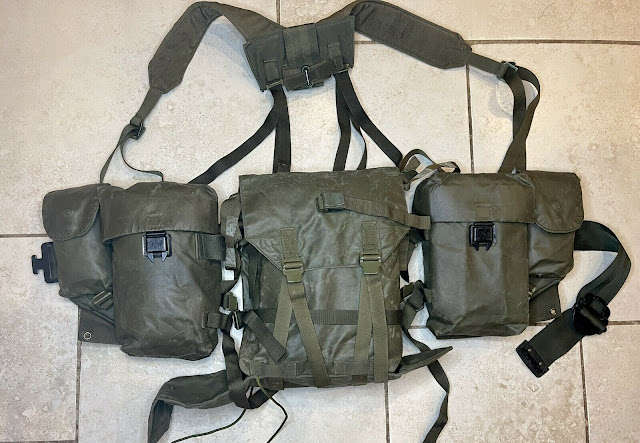
Ammunition Pouches / Left - Right
Utility Pouches
Haversack
Yoke

Date : 22/08/1973


History / Summary

The 1972 Pattern Webbing was intended to replace the 58 pattern webbing, but never got beyond user trials. It was made from PU-coated nylon to counter the Soviet NBC capability with a general look closer to a load-bearing vest. It was designed to be used in wide variety of environments such as jungles, deserts and was configurable for use, ranging from short-duration jungle patrols to general infantry use.

British Army 1972 72 Pattern Webbing Nylon 
Butyl laminate is in good condition

Machete Sheath and yoke shovel/pick attachment all complete


---------------------------------------------------------


British Army 72 Pattern Webbing System / Items


72 Pattern Webbing System

....
..

Osprey MK2


xx


-----------------------------


This is a mint condition set of SAS issued trials butyl webbing. The only other sets of these that I have seen have been in museums so grab yourself a great deal. It is all held together with webbing tape and has ammo pouches, a large pouch at the back and another holder under it. There is a small crack in the plastic at the end of the waist belt but all other clips and fasteners are in immaculate condition, no scratches. This was part of a system trialled by the British in the early 1970's but never went into general service outside the SAS. Other items that were used were the GS Bergen and the SAS/Para Bergen. You won't see one of these for a while so .


British Army 72 Pattern Webbing System


72 Pattern Webbing System

....
..


xx


.....


I have deliberately named this as being the 72/75 pattern in this post rather than the 72 pattern as I have done previously. I have been informed that the term 72 pattern is a collectors’ term and the official designation was the 1975 pattern PLCE set- this name would today cause far more confusion as the pieces are all dated 1972 or 1973 and PLCE is more commonly associated with the 1980s and 90s sets.


In 1975 the MoD doughnuts produced a second trials set that they called the “1958 Mk2”. Talk about confusing!

In QM stores, the adopted items linked to this set were called ’72 Pattern. MoD got it wrong but army got it right. I think the MoD confused the ’75 Pattern with the earlier ’72 Pattern.

Are you sure that there are two versions of the rear pouch? The “flaps” of the pickaxe head sleeve can be folded in above itself, thereby disappearing from view. The poncho rolls up and goes under the rear pouch flap, secured by the two adjustable straps there. The golok is carried, seemingly dangling from the amm pouch.

There are a couple of adjustable straps that connect to the rear of the yoke for carrying NBC smock and trousers. These seem to be very rare. So is the rear pouch liner – which I’ve never seen. Much like those drawstring bags they issued for PLCE rucksack main compartment and side pouches.

The field pack for this set became the “GS Rucksack” after a tad of modification. The frame was deepened, the side pockets switched from the breakable plastic pronged fasteners (on the large util pouches and on the front of the SAS Combat Pack) to an adjustable strap and the buttonhole affair on the “pocket” for the frame was dispensed with.

I’d REALLY like to know what the “buttonholes” on that thing are for…


In the early 1970s the British Army trialled a new set of webbing designed for the nuclear age. This new webbing was the first to move away from cotton weave to a butyl nylon that could be easily decontaminated. The webbing system was a radical departure from previous design and had some innovative features that were not followed up on subsequent designs. The webbing system was officially known as ‘75 pattern’ by the MoD, is commonly referred to as ’72 Pattern’ by collectors and was actually introduced as early as 1971…complicated enough for you? As can be imagined, components for this set of webbing are rare and so far I only have two of the four main components. We kick off tonight looking at the left hand pouch assembly:


- for lovers of Rare equipment -


Webbing 72 was created to overcome the main flaw of webbing 58: its substantial impossibility of being decontaminated in case of use of NBC type weapons. The need grew stronger during the 1960s, when the secret services of some NATO countries obtained first-hand information regarding Soviet conflict strategies in Europe and the research that Russia was carrying out in the field of aggressive chemicals. On the basis of these premises, it was practically certain that the Third World War would be fought in a heavily contaminated environment: cleaning the webbing 58 would have been a truly complex operation due to the permeable and absorbent material with which it was made (cotton). After a first attempt to cover each element of webbing 58 with a nylon-butyl fabric layer, it was decided to create a new luggage by directly using waterproof material and simplifying the design. The "pieces" of the series that were also successful and were produced and distributed on a large scale were the backpacks (GS and Para berghen) and the gas mask pouch


for more info please read this article, by an unmatched industry expert

https://talesfromthesupplydepot.blog/2019/06/05/1972-pattern-butt-pack/


72 Pattern Light Weight Combat Pack / SAS Vest


Pattern 72

Light Weight Combat Pack

1970s


...


Nomenclature

Pack, Lightweight Combat


PART NUM.
---
TITLE
---
DATE
---
FORMAT
---
COLLECTION
---
ACQUISITION
---
REFERENCE
----


Description

The Pack, Lightweight Combat was manufactured by several firms including Chelsea Quilt Company, commonly known as CQC, Ltd, and Mills Equipment Company (MECO). A common misconception is that this is the 72 trials pattern webbing because of its similar cut and materials, but while both were manufactured from Butyl rubber, they are distinctly different pieces of kit. The Lightweight Combat Pack was often used by UK special operators because the large ammo pouches to the front were adaptable to a wide variety of magazine types from Bren to Armalite magazines. The original model also often incorporated a specific pocket for SLR (FNFAL) magazines sewn to the front of either side’s large pocket to facilitate quick reloads. The lightweight design was intended specifically for use in tropical environments but often saw action in other regions, especially the desert.


History / Summary
The 1972 Pattern Webbing was a webbing intended to replace the 58 pattern webbing, but never got beyond user trials. It was made from PU-coated nylon to counter the Soviet NBC capability. It was designed to be used in wide variety of environments such as Europe, jungles, deserts and was adjustable for use, ranging from short-duration jungle patrols to general infantry use. 72 pattern webbing rarely appears on the collectors market.


Share This Page


Pattern 72 Webbing 


British Army Experimental Pattern 1972 Ammo Pouch Pair


Trialled by the British Army it was never put in to general issue.


The two front pouches are manufactured from two layers of PU-nylon material for rigidity and abrasion resistance, mounted on a double-thickness backing section. A broad nylon strap with two eyelets and a plastic quick-release buckle on a tape tab is stitched to this material. Each pouch could hold three, 20 round 7.62mmL1A1 Self-Loading Rifle magazines.

Left hand pouch: Good used and complete.

Right Hand: The right hand pouch is the rarer item to find. This one had been user modified with the addition of a QR buckle and side straps removed.


RARE British Army 72 Pattern Radio Carrier Pouch


Webbing Carrier
NSN : 5820-99-139-6162


British 72 patt/'nylon 58' pattern pouch for personal radio.


This limited issued kit is scarce and goes for a lot of money. c.1970s. 

I have not seen one of these on here in a long, long time. has label with NSN number.
Could this have been fitted in place of kidney pouch on web gear?


British Army GS Bergen 72 Pattern


British Backpacks

British GS (General Service) Bergen

1984
....


....


Nomenclature

GS Rucksack
NSN : 8465-99-132-2813


PART NUM.
---
TITLE
---
DATE
1984
FORMAT
---
COLLECTION
British Backpacks
ACQUISITION
CT2A-1919
REFERENCE
CQC


Description
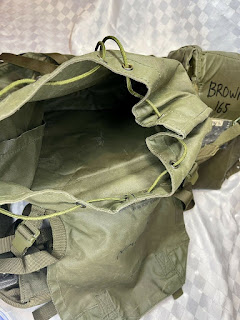
British army GS (General Service) Bergen dated 1984.
Complete with frame


History / Summary
As part of the '72 Pattern Trials web set, there was a smaller rucksack. The Trials rucksack was modified and then issued as the "GS Rucksack". (NSN : 8465-99-132-2813) Note that the "GS" stands for "General Service", ie: standard issue.


Bergen GS / SAS 


British Army SAS/PARA Airborne - Bergen / Rucksack


British Backpacks

British SAS / Para Bergen

..


'72 Patt "Rucksack SAS"
SAS/PARA Airborne - Bergen

NSN : 8465-99-136-1886


This guide is intended to help Ebay bidders avoid being scammed by unknowledgeable and/or dishonest sellers. It also sheds light on the term "Bergen".

All British soldiers today call their rucksacks "Bergens" (Often miss-spelt as "Bergans"). The term comes from the original '42 Pattern external 'A' frame rucksack that was closely modelled on skiers' rucksacks made or used at Bergen, Norway.

Elite units, ie: Airborne Forces (SAS, Para, Gliderborne and Glider pilots) and Seaborne Forces (Commando), were issued these rucksacks. Because of the nature of their operations, they were required to be self-supporting and, usually, carry all that they needed to survive and continue their operations independently of the larger logistical structure of the army. Hence the term "Bergen Soldiers", a phrase that seems out of date today. The ethos remains the same: self-reliant, fighting elite men who tackle the most dangerous missions, operate independently in isolation and for protracted periods.

The '42 Bergen was replaced by the '72 Patt "Rucksack SAS" - also known as the "SAS/PARA" or "Airborne" Bergen. (NSN 8465-99-136-1886) This had a square external frame that was also used for carrying the Clansman PRC 351 and 352 radio sets. From habit, these were called "Bergens" - despite the fact that, strictly speaking, they weren't because of the shape of the frame and pack.


With the introduction of the PLCE webbing, the '72 Patt Rucksack was replaced by the '90 Patt PLCE internal frame rucksack which, a short while later, was replaced by the '95 Patt. The '95 Pattern was identical except for it's camouflage fabric. Both types of these rucks had numerous variants: convoluted backs, quick release shoulder straps, etc, and they come in two sizes, "Long Back" and "Short Back". All of these are standard issue and not exclusive to elite fighting forces.

As part of the '72 Pattern Trials web set, there was a smaller rucksack. The Trials rucksack was modified and then issued as the "GS Rucksack". (NSN 8465-99-132-2813) Note that the "GS" stands for "General Service", ie: standard issue. These are frequently being offered on eBay as SAS or PARA and/or as SAS and PARA "Patrol Bergens": these claims are completely false and they're an attempt to sell an inexpensive, standard issue item as elite fighting forces kit. The GS rucksack was far too small for Airborne Forces use and were banned for use in Airborne units, not that the ban had to be enforced: no self-respecting Para would want to be seen dead with this rucksack! Only trainees on an All Arms Para Selection Induction might be permitted to use these whilst they were a undergoing Selection at Depot PARA, Aldershot. Once qualified and in an Airborne unit, they'd have to carry full scales of equipment like everyone else in the unit.

The main tips to recognising a genuine SAS/PARA "Bergen" from a GS rucksack are easy. The GS is far smaller, has no zipped compartment in the lid, no zip on the outer central pouch and the lid closure straps are buckle adjusted instead of tied. There is no provision for sliding a shovel or skis behind the side pouches. There are no snapper studs on the side pouches (for folding and securing them flat), no accessory loops on the body front and lid and there are two visible 1" straps on the lid, leading to the D Rings for the shoulder straps. Do not be fooled if a rucksack is photographed on the same frame - the GS is designed to be used with the same frame and shoulder straps. With the frame fitted, very little equipment can be carried in the main body - certainly not enough to make fitting the frame worthwhile!

One final point: Originally, all '72 Pattern rucksacks had manufacturer details ink stamped onto the inside lids. On earlier rucks, these were very neat and they numbered several lines. After a time, the "SAS" was omitted from the line "Rucksack, SAS". On some production batches, there is extremely little in the way of markings - and some are "sterile", ie: with no markings at all. Later rucks have markings that appear to have been hand rubber stamped on. The markings, or lack of them, do not necessarily indicate an imitation.


If in doubt, leave it out...


Highlights