The flag of the three armies, with a red background, a width-to-height ratio of 5:4, and a golden five-pointed star and the word "August 1st" on it, indicates that the Chinese People's Liberation Army has gone through an arduous and long-term struggle since the Nanchang Uprising on August 1, 1927.
East German (DDR) army webbing evolved from early leather gear to specialized load-carrying systems like the late-Cold War UTV (Universal-Tragevorrichtung).
Standard NVA Webbing (1960s–1980s)
The primary system used by the National People's Army (NVA) was characterized by its grey-green nylon or canvas material. Belt: Heavy-duty grey webbing with a distinct silver-colored metal buckle featuring the DDR state emblem. Support: Unlike many Western systems, the NVA did not widely issue shoulder Y-straps until later; instead, they often relied on belt hooks or breadbag straps for support. Pouches: Standard kits included ammunition pouches for the AK-74/AK-47 (often in Strichtarn "rain" pattern camouflage), a canteen, and a gas mask bag.
UTV System (The 1990 Modernization)
The UTV system was intended to be the DDR's ultimate load-carrying equipment for the 1990s. Heavily influenced by the British 1958 Pattern webbing, it was designed as a single, unified set that would not fall apart when removed. Design: It featured an H-harness yoke with "C" hooks for belt attachment. Legacy: While trials began in the 1980s, the system was never fully introduced into service before the reunification of Germany, making unissued sets common in the surplus market.
Early Camouflage VariantsBlumentarn: Rare early webbing components (like map cases or small backpacks) exist in the 1950s/60s "flower" camouflage pattern. Strichtarn: The most iconic DDR pattern, used for the majority of late-issue pouches and field packs.
NVA Koppeltragehilfe-Tragegestell is a central component of the personal load-bearing equipment used by the National People's Army (NVA) of East Germany (DDR). Depending on the era, there are two primary systems:
This is the most common model, utilized for decades until the end of the Cold War.
Material: Usually made of robust webbing (Dederon or cotton blend) in stone gray or olive.
Function: It distributes the weight of the belt (which holds the canteen, entrenching tool, magazine pouches, and gas mask bag) onto the shoulders.
Attachment: It features hooks that clip into the eyelets of the belt and rear straps to attach the "Sturmgepäck" (assault packs) Part I or Part II.
2. The UTV System (Universal-Trage-Vorrichtung)
The UTV K 61 you mentioned is part of the modernized equipment introduced in the late 1980s to improve comfort and modularity.
Design: Visually more similar to Western systems (such as the US ALICE system).
Special Features: The shoulder straps are wider and often padded. Pouches are no longer attached solely via loops but via special plastic or metal clips.
Rarity: Because the UTV system was slated for full-scale introduction just before the fall of the DDR (c. 1990), original pieces are highly sought after by collectors and more expensive than standard equipment.
Tips for Collectors and Buyers (As of 2025)
If you are looking to purchase this harness, keep the following points in mind:
Condition: Check for rust on metal hooks and ensure the webbing straps are still pliable. "New Old Stock" (NOS) items are the most desirable.
Completeness: Ensure all adjustment sliders and strap end-caps are present.
Where to Buy:
eBay & Classifieds: The largest selection of private and commercial listings for NVA militaria.
Specialized Surplus Stores: Shops like ASMC or Army-Store24 occasionally carry remaining stock, though authentic UTV gear has become quite rare in 2025.
Militaria Forums: Platforms like the NVA-Forum often host marketplaces for authentic pieces.
Note: The designation "K 61" often refers to internal production codes or classifications; among collectors, the item is most commonly searched for as the "UTV-Tragegestell."
The shovel cover is a "last-issue" UTV, (Universaltragevorrichtung ), pattern. This style of of attachment and webbing was was developed in the late 1980's as a replacement to the earlier pattern East German field gear. The UTV gear was produced and stored in large quantities, in warehouses, but was never issued out to the general troops. It was worn in the field by a few East German Army observers that were invited by NATO to a joint military maneuver around 1990, but aside from that, the UTV gear was never issued, and ended up being sold off as surplus after the reunification of East and West Germany.
The UTV gear (Universaltragevorrichtung ), was the East German equivalent to the US styled LBE, or Load Bearing Equipment. Basically the changes were a better combat harness-suspenders, green nylon webbing and a new attachment set up. The UTV items can also be recognized by their green metal fittings. There were also UTV grenade pouches, canteens, ammo pouches, gas mask bags, and pistol holsters produced in this style that were never issued, but are now found on the current surplus market.
Feathures
UTV (universal carrying device) for the folding spade of the NVA or the border troops of the GDR.
NVA UTV Gasmaskentasche für Schutzmaske in strich tarn (UTV)
The NVA UTV Gas Mask Bag in "Strichtarn" (Rain Pattern/Line Camouflage) is the modernized version of the NBC (Nuclear, Biological, Chemical) protection bag. It was introduced in the late 1980s as part of the Universal-Trage-Vorrichtung (UTV) system.
Features and Design
Unlike the classic gray rubberized gas mask bags commonly associated with the NVA, the UTV model features several distinct upgrades:
Material: Made from a durable blended fabric (approximately 60% polyester, 40% cotton) featuring the iconic East German "Rain Pattern" (Strichtarn).
Attachment System: The back is equipped with specialized plastic or metal clips designed specifically for the wider UTV belt. However, these clips are often versatile enough to be used with standard belts.
Dimensions: Typically measures approximately 28 cm high, 28 cm wide, and 10 cm deep.
Purpose: It was designed to carry the protective mask (such as the M65 or TSM models), the filter canister, and additional NBC accessories like the protective cape or gloves.
NVA gas mask bag in the new UTV design which should be used from 1990. Has several useful pockets. It can be worn on the gray field belt as well as also at UTV field belt.
Measures approximately 29 x 29 x 10 cm (H x W x D)
The M58 Flachtarnenmuster pattern was issued between 1956 and 1967 to units in the East German Army (NVA) and Ministry of Interior (MDI). Also known as Kartoffelmuster (potato camouflage) or Blumentarn (flower camouflage), the pattern generally consists of blue-green, olive green & brown ragged blotches on a field grey background. Several mild color variations have been documented, some of which may appear darker due to their having been coated in anti-gas chemicals (which also gave the fabric a waxy texture). Several types of jacket, trousers, field equipment, shelter half and hood/helmet cover were produced in this pattern.
Produced between 1965 and 1968, and in use for several years thereafter, the first type Strichmuster (line pattern) is a very simple pattern incorporating long, slender brown rain straits on a light greyish-green background. The "rain" theme was common with many Warsaw Pact nations (Poland, Czechoslovakia, Bulgaria) and was probably influenced by WW2 German designs such as Splittermuster and Sumpftarn. This is generally referred to as 1st Type East German strichtarn.
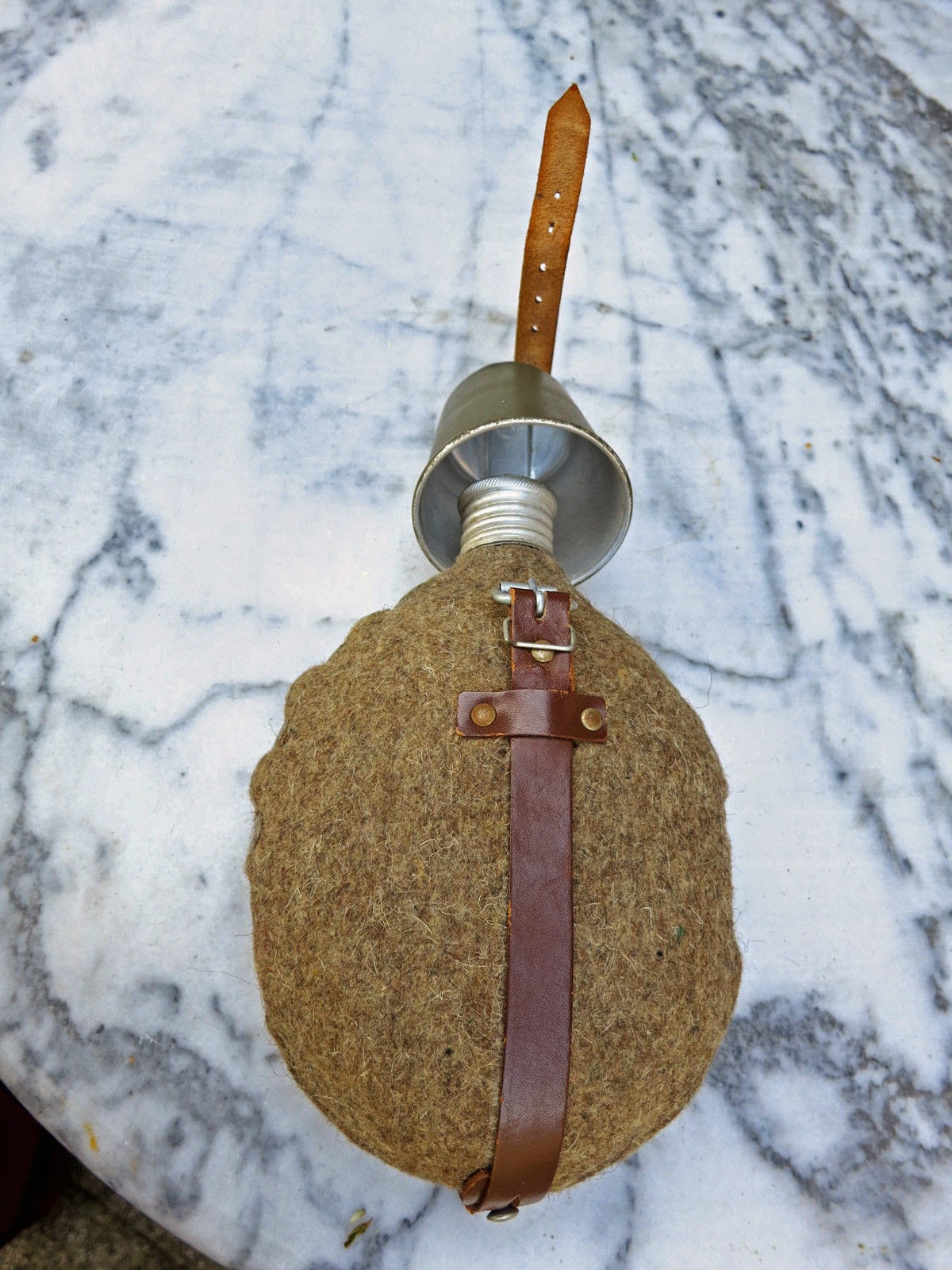
This is actually a classic German canteen, as it has been used for many
years in the German military. The canteen is an aluminum bottle with aluminum
cups and aluminum screw cap.
1952-1956
Feldflasche Blumentarn
As the successor to the aluminum canteen this
plastic-bottle was introduced.Blumentarn was introduced around 1958 The
bottle was changed in shape, got a camouflage print with verse existing
canteen cover, still in Flächentarn, with an aluminum cup, plastic screw,
pouch with snap hook. Capacity 0.65 liters
1958-1970
Feldflasche Einstrichkeinstrich
As successors of the canteen cover in
Flächentarn , Strichtarn-Raindrop pattern was introduced the
Plastic bottle with an aluminum cup, plastic screw, with hook pouch remained
unchanged.
Capacity 0.65 liters
1965-1989
Feldflasche Isoliert
Thermoflasche
The canteen was isolated intended for use in
the winter, equivalent in size to the normal canteen is also a plastic water
bottle with plastic screw cap has a plastic insulating cover, a
Kunststoffberiemung and an aluminum cup.
.svg.png)

.svg.png)




.jpg)


